
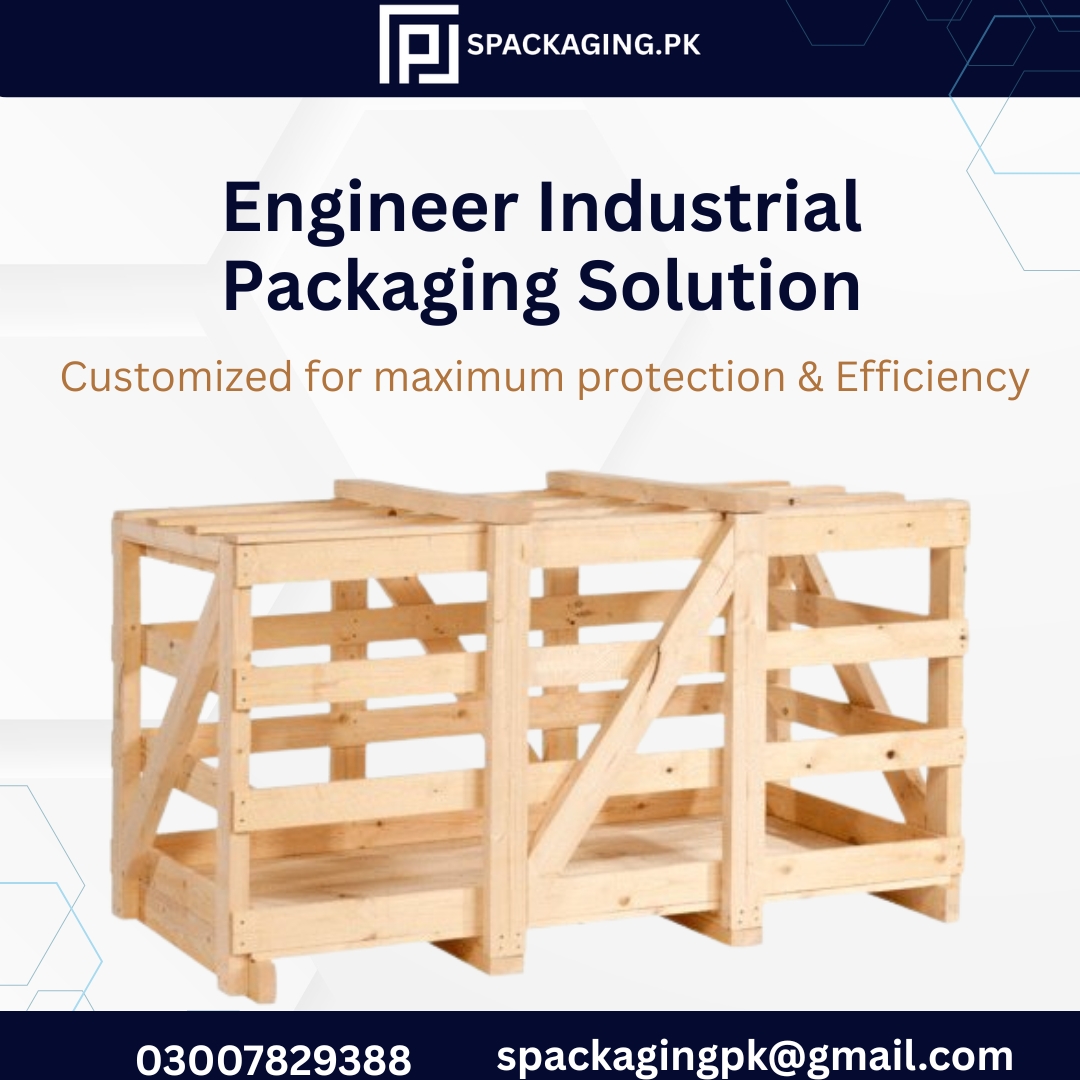
If your business handles storage, transport, or exports, you already know one truth. Weak packaging costs money. Broken goods, wasted space, slow handling, and customer complaints all trace back to poor crate design. A stackable wooden crate solves these problems in one move. It protects your goods, saves warehouse space, and improves handling speed.
Stackable wooden crates stand at the center of modern logistics. Factories, exporters, warehouses, farms, and retail supply chains depend on them every day. At spackaging.pk, this product forms a core part of industrial packaging solutions built for real load, not showroom display.
A stackable wooden crate is a rigid timber container designed with reinforced base and top edges so multiple crates lock safely on top of each other. Load stays stable. Movement stays controlled. Storage stays organized.
These crates differ from ordinary wooden boxes in three ways:
• Structural strength for vertical stacking
• Load distribution on corners
• Precision fitting for stable alignment
This design reduces floor usage and increases vertical storage capacity without risking collapse.
Warehouses now focus on vertical space. Transport costs rise every year. Damage margins shrink. These pressures make stackable designs a necessity.
Key business gains:
• Saves up to 40 percent floor space in storage
• Speeds up forklift and pallet handling
• Reduces breakage during transport
• Improves inventory visibility
• Lowers logistics cost per unit
Stacking strength equals profit control. Weak packaging destroys margins fast.
Stackable wooden crates serve many sectors because wood handles both heavy and sensitive loads when engineered right.
Common users:
• Export companies
• Manufacturing plants
• Agriculture suppliers
• Warehouse operators
• FMCG distributors
• Auto parts suppliers
• Machinery exporters
• Marble and stone traders
Each sector values three traits: load strength, air circulation, and reuse life.
Not all wooden crates perform the same. Performance depends on wood species, moisture level, and cutting accuracy.
Common materials used at industrial level:
• Pine wood for export packaging
• Hardwood for heavy machinery
• Treated timber for moisture resistance
• Fumigated wood for international shipping
SPackaging follows ISPM-15 treatment standards for export-grade crates. This protects shipments and clears customs faster.
A true stackable wooden crate does not rely on nails alone. It depends on engineered joints, corner posts, base runners, and timber thickness.
Standard load ranges:
• Light duty: 150 to 300 kg
• Medium duty: 400 to 800 kg
• Heavy duty: 1000 to 2500 kg
Load safety multiplies when stacking up to four levels in controlled warehouses.
Different operations demand different crate styles.
Most used designs:
• Solid panel crates for machinery
• Slatted crates for ventilation
• Reinforced base crates for forklifts
• Collapsible stackable crates for return logistics
• Export sealed crates with inner cushioning
Each design changes cost, strength, and reuse life.
Plastic crates serve light retail handling. Wood rules heavy logistics.
Key differences:
• Wood handles higher static load
• Wood absorbs shock better
• Wood performs better in long-distance freight
• Plastic fails under heavy vertical stress
• Wood supports custom sizing
For industrial supply chains, wood remains the trusted choice.
Standard sizes rarely fit all cargo. Exporters, machinery vendors, and agriculture suppliers need precise internal clearance.
Customization options:
• Crate length, width, height
• Load rating design
• Forklift entry direction
• Branding on panels
• Internal foam or block supports
• Waterproof lining
SPackaging designs according to real cargo weight, not guesswork.
Export failures cost far more than local transport damage. Ports, container yards, and sea waves punish weak packing.
Stackable wooden crates handle:
• Vibration
• Vertical compression inside containers
• Long exposure time
• Rough crane handling
• Multi-stage transit
ISPM-15 treatment protects exporters from shipment rejection at destination ports.
Warehouses now chase three goals: capacity, speed, and safety.
Stackable wooden crates support all three:
• Vertical storage increases rack efficiency
• Stable stacking reduces human handling
• Forklift access saves labor time
• Organized stacking improves stock control
Poor crate geometry kills warehouse productivity.
Wood remains one of the few packaging materials built on a renewable cycle.
Environmental advantages:
• Wood biodegrades naturally
• Reusable for multiple shipment cycles
• Repairable after partial damage
• Low carbon footprint compared to plastics
Sustainability now drives buying decisions in export markets.
Serious buyers demand compliance. Packaging standards protect both exporter and importer.
Common standards:
• ISPM-15 for international shipping
• Heat treatment certification
• Moisture control
• Load test verification
• Dimension tolerance testing
SPackaging follows industrial inspection at production.
Wrong selection leads to crush damage, shifting loads, and stacking collapse.
Selection checklist:
• Cargo weight and density
• Stack height in warehouse
• Transit method
• Moisture exposure risk
• Forklift and pallet size compatibility
Crate design must follow cargo behavior, not seller templates.
Cost Factors of Stackable Wooden Crates
Prices change based on raw timber, treatment method, and load rating.
Main cost drivers:
• Wood thickness
• Treatment process
• Custom dimensions
• Load strength
• Internal padding
Cheap crates raise shipment risk sharply.
Importing crates increases lead time, taxes, and mismatch risk.
Local production benefits:
• Faster delivery
• Custom sizes on demand
• Lower freight cost
• Direct quality inspection
• Faster revisions
SPackaging serves local and export markets with fast turnaround.
The process stays simple and production-focused.
Steps:
• Share cargo details
• Receive design and load plan
• Approve samples if required
• Production begins
• Final inspection
• Dispatch
No delays, no confusion.
What makes a wooden crate stackable
A crate becomes stackable through reinforced corner posts, flat load-bearing top edges, and weight distribution design.
Are stackable wooden crates safe for export
Yes. When heat treated and fumigated under ISPM-15, they meet international shipping rules.
What weight can a stackable wooden crate carry
Industrial designs carry from 150 kg up to 2500 kg per crate based on timber thickness.
Do stackable wooden crates reduce warehouse cost
Yes. Vertical stacking increases usable space and cuts handling time.
Do wooden crates protect fragile goods
Yes. When supplied with internal supports, wood absorbs shock and controls movement better than plastic.
Can SPackaging customize crate sizes
Yes. Sizes, strength rating, and structure follow client cargo needs.
Do stackable crates work with forklifts
Yes. Base runners allow two-way or four-way forklift access.
Are wooden crates reusable
Yes. Quality crates support multiple shipment cycles.
A stackable wooden crate defines the backbone of safe industrial packaging. It controls damage, saves space, and improves logistics discipline. Weak packaging destroys profit. Strong stacking preserves it. Businesses across Pakistan rely on SPackaging because production follows engineering rules instead of shortcuts. When load strength, export compliance, and reuse life matter, SPackaging remains the trusted choice for stackable wooden crates.